Tuesday, July 23, 2013

Coming Home


Coming back home after a week away for vacation is always a pleasure.  Usually everything is the same as when I left, but this time there were differences. A sample:
1.      There is a chicken living in my house, a captive chicken as distinguished from the wandering chickens that roam around town.  This chicken is tied up in what used to be the dog’s pen, the dog having been relegated to outdoors where he does fine except when it rains. I didn’t even notice the chicken the night I got back home from vacation, although there was a kind of odor.  I saw her as I was washing my clothes the next morning, standing still, beady eye fixed.  I asked Candida, “Why is there a chicken in the house?” although I knew the unhappy answer. “For sopa de gallina,” she confirmed.  So tomorrow morning the chicken is sacrificed for chicken soup.  Candida will do the sacrificing and I will be, I hope, at school.  Will I eat the soup, if offered?  Of course.
2.      There still was a mouse in my room.  I thought maybe he had gone away on his own since I didn’t see him for a few days before I left. But my first night back he shot across my floor, the big, black mouse I remembered.  I looked up the word for poison in my dictionary and set out to find some, this mouse, for weeks, having failed to abandon my room despite the absence of food there and the nudge of the open door.  He was going to have to die. You can’t buy poison in all the stores in town, only at the store where the lady sells liquor.   She sold me a “pill” of poison for 6 cordabas and for free gave me instructions.  You crush the pill till it’s powder and then you mix the powder with rice.  Only rice will do—I have that on the advice of many people.  Then you put the poisoned rice on the floor and two days later you have a dead mouse. Under the bed, in my case.  You know you have a dead mouse by the smell in your room.  You dispose of the mouse and the poisoned rice in a plastic bag.  End of story.
3.      My friend Marisol planted an herb garden in my absence and she was excited to show it to me.  Her house has a big back area where grow trees she maintains to help feed her large family.  There are banana, plantain, and several kids of fruit trees.  She has a couple of avocado trees.  She has trees whose roots provide traditional Nica favorites like yucca and malanga.  I was admiring the flower at the end of a big bunch of plantains and so she cut down the tree with a machete to show me the flower and, of course, to harvest the plantains.  Where I protested killing the whole tree, she pointed out the stubs of trees all around and all the small plantain trees growing to take their place.  I guess that’s how it’s done.
4.       The kids at school are practicing for the English Song Festival next Monday. Last year I was pretty much a one-woman festival organizer and facilitator, but this year the principal made it plain that the English teachers should do all the work and I could help if they asked me.  I’ll be interested to see how it turns out.  Already there are signs that it will be good.  For one thing, because of a time crunch, last year I picked all the songs and we taught each grade level one song.  This year students are coming up with songs in English they want to sing.—better motivation. Also the Festival anticipated small groups of students performing and that’s happening this year.  The downside is that there’s less emphasis on getting words right and more on getting the accompanying dance routines down. Still, tomorrow I’ll spend an hour tutoring different groups to improve pronunciation.
5.      It’s Fiestas Patrias in my town.  Every town has such a festival celebrating its patron saint. I missed out on it last year except for the hipica (horse parade), which I caught.  I have been looking forward to seeing the rest of the fiesta.  In the bigger places there are extravagant parades with folkloric costumes and masks and the acting out of Nicaraguan legends. Not so in my small town.  Around the park is a food vendor, a seller of cheap plastic stuff for kids and a shirt salesman.  So much for the “feria”, the fair.   A tenth of a kilometer or so down the highway is a carnival with rides.  That I will avoid, but I am told there will be music one night, probably this weekend and I’m looking forward to that. Fiestas Patrias is an event much anticipated.  It’s a diversion from the usual, but I am kind of fond of the usual.
6.      Things have been a little slow at school.  To begin, after vacation, sometimes kids do not return to class right away.  All my teachers are either sick or caring for a sick and hospitalized family member. Because of this I’ve only been able to co-plan and co-teach half my usual load of classes this week. But the slow start to the new semester has been welcome as I recovered from my trip to Solentiname.
That’s what’s new in the north. 

Wednesday, July 17, 2013

Solentiname


I started dreaming of Solentiname before I left the U.S. This little archipelago isolated in Lake Colciboca near the Rio San Juan and the Costa Rican border has a compelling recent history, or at least it resonates to me. What I read before I left was that the group of some twenty little islands was sparsely  inhabited and ignored by everyone until Ernesto Cardinal, a priest, poet and artist, went there in the early 1960s to found a kind of communal society, organizing the campesinos.  Cardinal was influenced by, and helped to influence, the liberation theology movement which emerged in Latin American countries as a response to Vatican II and to the social and economic inequality pervasive then.  Christ was radically conceived as champion of the poor. But to this mix of Christianity and campesino culture, Cardenal introduced a third element—art.  He gave the people paint and canvas and brought an artist friend from Managua to teach them rudiments of painting.  And they painted the world they saw in a primitive style, the paintings full of what Solentiname has in gorgeous abundance—water, birds, animals, flowers. The style and skills have been passed along to the next generation but there are still painters on Solentiname who were part of the original experiment.
When my sister and niece were visiting we explored the Rio San Juan, but I wanted to see Solentiname and so we made an overnight trip, arriving at 4:30 one afternoon and leaving at 5 in the morning the next day.  Not much of visit, but enough to tell me I had to come back.  There is magic in Solentiname and great peace and beauty.  No cars, no cell phone service, no electricity (on most islands) except what people generate with solar panels. But there is the art and it is something.   I took the opportunity of a school vacation to set out by myself on the long journey from my site to San Carlos (10 bus hours) and by lancha 2 hours across the lake to the archipelago. And I brought money.  I had seen enough on the previous trip to know that I wanted a Solentiname painting to bring home, a gift to myself after two years of service and a reminder of the natural beauty of Nicaragua.
There are tourist facilities on only two islands.  I had previously stayed on Mancarrón where I saw Cardenal’s beautiful white church.  But most of the art is on two islands,  La Venada and San Fernando, so I stayed on San Fernando, the only other choice.  In the whole archipelago there are only about 2000 people, spreadout over maybe 15-20 islands. I lucked out in the hotel I stayed in, not because it was so wonderful, but because I made friends with two nice Nicas there. Olivia, the daughter of the owners, surprised me by speaking to me in English the first morning when I came to the kitchen early looking for coffee.  We sat down there and chatted while she was preparing breakfast. Olivia explained when I asked that she learned her English on her own with the help of three lucky factors.  She studied for five years in a University in Managua on full scholarship, although she took only two English classes and those specialized for her major, environmental science.  She also was able to study abroad on scholarship twice, one full year in Germany and a month in Turkey. It was in Germany she picked up the English.  Why was she back in Solentiname cooking at a hotel? (I hope I put the question to her more delicately) Well, she explained, that’s her home and she had been unable to find work (This is the sad song of too many educated Nicaraguans.  They study but find no jobs.) I expressed surprise, suggesting that it would seem that with her major and her excellent English she could work for an NGO.  She said that when she put “self-taught” on her resume as the source of her English ability, potential employers discounted it, preferring credentialed English speakers. What a shame.  She is better than most.
The conversations continued later that morning when she agreed to lead me on a hike to a lookout and site of petroglyphs. (Hiking in Nicaragua can be dangerous solo.  Trails just aren’t marked and they criss-cross in a way familiar to the inhabitants but not to visitors.  In fact, Olivia told me, a foreigner had died on a trail on the island when he fell and shattered a leg.  His body was not found until much later because no one knew he was missing or where he had gone.) The hike was muddy.  Torrential rain fell as we huddled under an overhang at the island elementary school (two classrooms areas in one building).  The view was worth the hike and the soaking. On the way back, Olivia pointed out the houses of some artists and I looked at some paintings. She also helped me locate a man with a boat to take me in the afternoon to La Venada where a large family of artists lives.  I spent the rest of the morning at a gallery where the paintings of many artists were exhibited, a great opportunity to examine the paintings closely and consider the prices, which seem to depend only on the size of the canvas.
The boatman turned out to be a guide as well.  He took me to five different houses, all located near each other and all with a few paintings set out to view. Obviously everyone was glad to see me and there was no awkwardness in looking and moving on.     I had made a list from the gallery of artists whose work I wanted to see and I also wanted to go back to see the work of Rudolfo Arelleno, the progenitor of the other artists in this little compound.  I saw his work on the last trip and really liked it, but I couldn’t afford his most spectacular paintings, big complex pieces, museum quality, in my untutored opinion. On this trip I ended up buying one of Rudolfo’s painting, a much smaller piece, but my eye was instantly caught by a painting in the house of a relative, a largish and beautiful example of the Solentiname style.  The artist quite rightly wanted a good bit for it.  She could tell I admired it.  When I said I couldn’t pay so much she shyly invited me to bargain.  I gave it a shot, both of us laughing and saying how we were no good at “negociando”.  We made a deal.  The boatman, I think genuinely, said it was a good painting and I waited while she took it off the stretcher and rolled it so I could carry it. I went back to my hotel with a singing heart. I had got what I came for and so much more besides.
The next day I spent at the little museum on San Fernando and at the library where I found a book describing another project—a poetry writing workshop on the island during Cardenal’s time.  I shared an avocado with a maid at the hotel, Jessica, and we talked for some time. That night Jessica introduced me to her daughter.  The next morning at 5 o’clock I was standing on the dock of the hotel, waiting for the boat to take me back to San Carlos.  Made it in time to take an 8 o’clock bus to Managua, a taxi from one bus station to another, another bus to Jinotepe and a third out to LaPaz, my training town.  After a 12 hour travel day I was so glad to see my old host mom and to bask in all that love and approval.  She really is something. This has gone on too long so I won’t detail the day I spent visiting old friends there except to say that I am most fortunately included in the list of people for whom by name Doña Petrona, my host mom’s sister, prays nightly. To this I attribute my health and happiness in Nicaragua, if not for its supernatural effectiveness , then for being held so kindly in the hearts of people here.

Sunday, July 14, 2013

Miss Instituto

Every year my high school ( instituto) celebrates its birthday.  It does so by cancelling classes (you correctly


hear a note of annoyance on the part of the killjoy voluntaria) and holding an “acto” with the usual dignitaries, folkloric dancing and student recitations of poems or essays about the importance of education, after which is held the Miss Instituto contest.  Note: not the Señorita Instituto contest. Last year I did not attend for some reason.  I’m sure I had another obligation, but I also remember being put off by a contest like that at our school.  I know, I know—in the states we have homecoming queens, same deal, but the pervasiveness of the glamour ideal for women, seen everywhere and almost always the sole ideal, is hard for a second wave feminist to see, let alone, participate in.  But this year I went to see what it was all about.
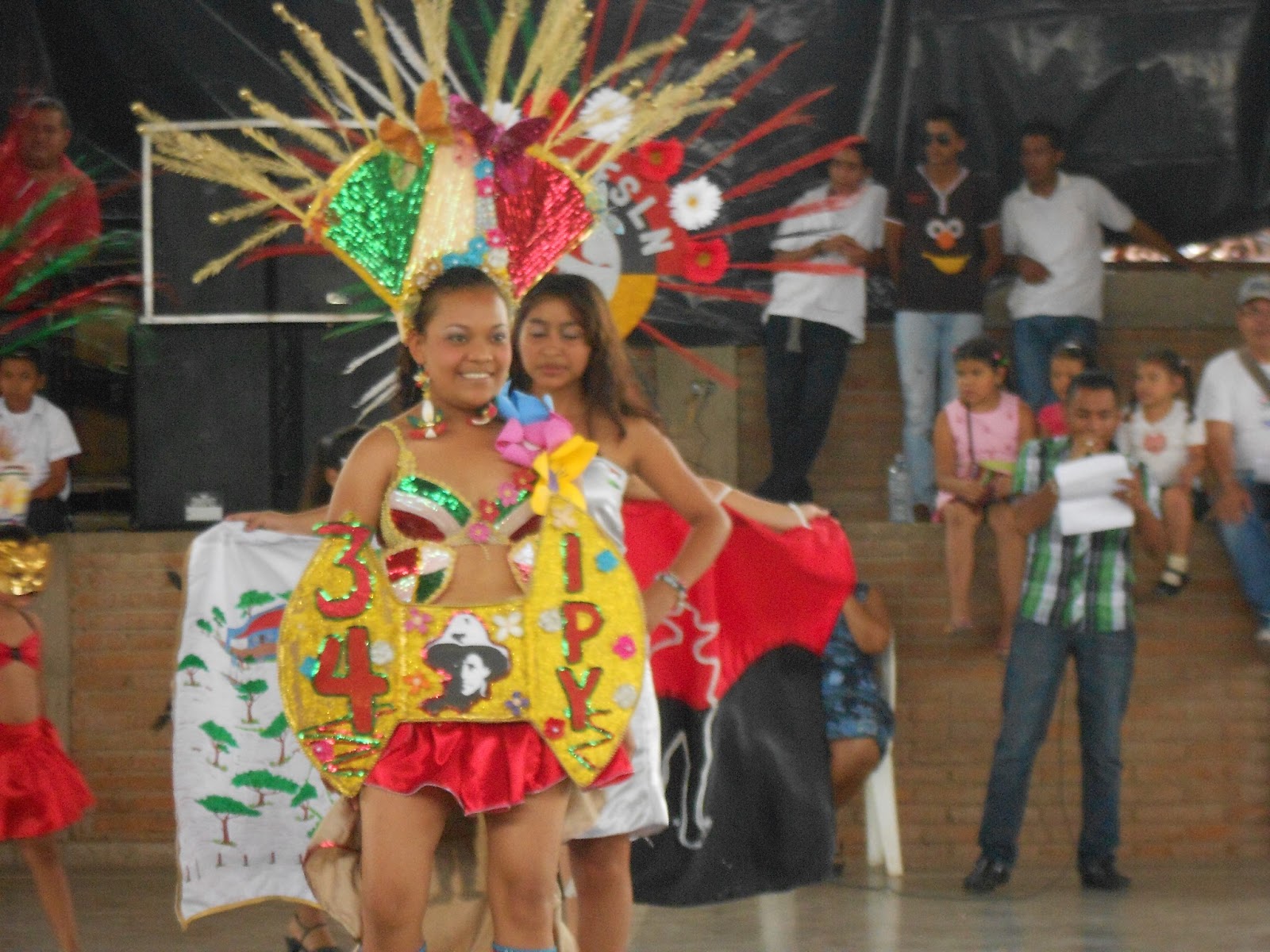
And I wouldn’t have missed it.  It defied expectations in spades.  First of all, boys participated as well as girls, the name of the event to the contrary.  Secondly, there were actually 3 different parts to both the boys’ and girls’ competitions.  One was the predictable runway parade in ball type gowns for girls and dressy clothes for the boys.  But there were two others parts.  In the first, both boys and girls wore home-made costumes celebrating the high school. They were elaborate with tall headdresses and trains and flowing capes painted with the symbols or scenes of the town and the school.  One dress was made entirely out of recycled soda cans and another out of all natural materials.  Some of the competitors were accompanied by little courtiers who lent more spleandor to the presentation.  The students paraded, the girls in impossible high heels, arms stretched to the side to show off the art work (and not incidentally, their bodies). They circled the sports center and then stopped to give a little speech (think Miss America on world peace).  The panel of judges filled out their score cards and the student audience went wild.
In the third part of the competition, the candidates paraded in school uniforms, but uniforms modified to fit their idea of some sexy academy in a city.  The girls’ skirts were super short, their shoes high heels, their blouses straining at the buttons.  They wore sassy little hats and carried cute handbags (in lieu of the ubiquitous backpacks) and sucked on lollipops a la Lolita. The boys, too, went sexy.  Some had ties loosely tied, for some reason a fashion item, suggestive of rebellion, maybe because ties aren’t worn here except by foreign businessmen. Everyone strutted, twirled, stood hand on one raised hip, other knee bent.    They threw kisses to the audience and the judges. And, again, there wild applause.
What do I think of all of this? I am still grumpy – and I should be—about the sexualization of girls in this culture.  Even some of the boys played into the sexual role, although some of the boys, mostly the younger ones had other fantasies, dressing as the great national hero Sandino in leather-ish jacket and big hat, or as soldiers with guns during the revolution. But the sheer inventiveness and sense of fun in some of the costumes in the first completion, the making of something spectacular out of paper, glue, paint and a little fabric, this was fun to see and it made me happy to think of my students using their imaginations, not only to design the costumes, but to figure out how to make them out of not much.
I’m not a fan of cancelled classes—but this one might have been worth it.  I’ll try to attach some pix.


Tuesday, June 11, 2013

Nice People

Sometimes I get so used to the real decency of people here when it comes to strangers I forget to note it.  But recently, traveling around some, I was reminded. I showed up at the bus stop to find the usual gathering of people with their boxes of chickens and baskets of rosquillas.  It’s always a good sign when there are people waiting for a bus.  It means one is coming.  The only question is to where.  So I always ask which bus people are waiting for.  That prompts the universal question here: “A donde va?”  Where are you going?  I remember being a little put out when I first got here—what business is it of yours where I am going?  But the question is ubiquitous—everyone asks everyone.  I’m not sure why.  Maybe it’s because to go somewhere is an uncommon event, worthy of note.  The answers are never that fascinating and no one really comments on your destination but they nod their heads, a little more enlightened: “Ah, Somoto.”   The bus I wanted was the bus to Somoto and that was the bus everyone was waiting for, too.  But a few older people were worried that I should wait for a bus. There is another alternative, a taxi, but it costs more and I like the bus just fine. I explained all that but that didn’t stop these concerned folks from signaling a taxi for me, anxious that I take the luxury transport, get there more directly, avoid the bus. I’m guessing they figured a gringa like me should take a taxi.  There was an awkward moment while I waved off the taxi driver.
Another day, another bus. Another nice man standing up to give me his seat, something that doesn’t surprise me anymore but it still delights me. Kids don’t do it.  It takes a man of a certain age, say 35 to 60, to remember his manners and give la señora mayor a seat. When I got to my destination I was walking around looking for my bank which is not with the other banks in town.  I asked a gentleman standing on the corner.  He though a moment and then said that I was going to have to take a taxi to get there.  Meanwhile I spied the bank halfway down the block.  I thanked him and took off for the bank.  What was he thinking? The truth is that he didn’t know where the bank was.  But he didn’t want to be unhelpful.  So he advised the taxi (surely the taxi driver would know where the bank was). This happens in one form or another all the time.  If you ask people for information, they want to help you.  They seem constitutionally unable to say they don’t know.  That isn’t helpful.  So they sometimes make stuff up.  In the value system it’s better to give wrong information (maybe it turns out right after all.  Who knows?) than no information at all.  For this reason you can’t really rely on what people tell you.  They aren’t lying; they are just trying to help.  Still, you have to double check all the time, ask multiple people.  If you get the same answer multiple times, maybe you can rely on it. 
Interesting how in this culture you can't always know.  More interesting is how used you get to living without being sure.


Thursday, June 6, 2013

Massage

It’s hard to believe I know but I enjoyed a real massage up here in my little town in the north of Nicaragua. This is how it happened.  I know a young man named Jorge who is a serious and responsible and modern 19 year old .  He is studying on Saturdays to be a nurse.  Studying on Saturdays is the norm here, the fortunate and unusually well-off students being the only ones who can afford to go to the university daily. Part of the problem is the cost of transportation, but I get the impression that studying on Saturdays feels to people like just the right amount of studying.  Anyway, Jorge’s course of study is 3 years after which he will be a nurse.  Part of his training was a course on alternative medicine including massage, which he took during a month or two of weekly trips to Managua.  
 But Jorge is also an entrepreneur.  There is a Swiss government initiative here to try to encourage new businesses.  It already has 2 projects operational, one a dressmaking workshop which is fitted out with some very nice machines and cutting tables, and the other is a bamboo workshop which has a building on the highway and employs a number of workers who make bamboo baskets for sale.  They come in 2 sizes, big ones for transporting rosquillas and smaller ones for gathering coffee beans. I think they also make a few novelty baskets for sale.  Every few years the Swiss government “partners” with the mayor’s office to identify other possible projects and then gives the new entrepreneurs business training, after which the Swiss put some serious money into the various projects.
 Jorge not only wants to be nurse, he wants to own a pharmacy and give professional massages.  He was chosen to be in the class of 3 would-be entrepreneurs given the chance to learn about business.  And at the end of the course, damned if the Swiss didn’t come through.  They built a big addition on the front of the house of Jorge’s family, fitted it out with floors, a ceiling, glass cases and inventory.  They also got him a massage table. (More below on the two other projects that got Swiss funding.) I heard about the possibility of a real massage while visiting La Farmacia del Angel to congratulate Jorge on his new enterprise.  He showed me the massage room, a tiny former bedroom in the house, dirt floored, adobe-walled with the usual tin (actually zinc) roof open to the sky at the eaves.  Jammed into the room, besides the enormous table, was the ubiquitous plastic chair and a tiny table (notable because tables are rare here) with a wooden incense holder and 2 types of incense. Jorge was ready to go.  So I booked an hour massage for the price of 100 cordobas, about $4.—a bargain by US standards but not something the average person here could do or would do.  I got the feeling I was the first paying customer.
I showed up on a Sunday afternoon with few misgivings and a lot of happy anticipation.  We navigated the potentially difficult issue of how much clothes removal was optimal and, encouraged by Jorge to disrobe as I was comfortable, I opted for naked on the theory that you get a better massage that way and besides there are no other issues when you are 68 and the masseuse is 19.  Besides in the States the therapists are expert at preserving one’s modesty as they manage sheets.  The only problem was that although Jorge had a table he had no sheets, but rather a bath size towel. Managing the towel worked out más o menos.  And at the first touch on my back I knew this was the real deal.  Jorge was tentative, but he knew what he was doing (unlike the sad little massage I had one day from some street vendors in Peru who had no training and thought of massage as sort of like a friendly back rub.) The massage moved as it should from back to legs to arms, chest and face with a successful turn over half way through.  Finally, there was a blissful head and face massage and, an hour and twenty minutes start to finish, we were done. Jorge gave me a minute to collect myself.  I opened my eyes to gaze out through the roof at the trees in the yard.  I was covered in a mixture of sweat and body oil, my hair a snarled mess.  I got up from the table and used the towel to mop up my body and the table.  I started to get dressed when I noticed that Jorge had left his several pages long massage instructions on top of my bag.  Glad to see he was paying attention. Dressed and left, wrapping my head in a scarf, and said good bye and muchas gracias to Jorge, promising to return again which I will. I have 5 months remaining in Nicaragua, enough time for 5 nice massages at my US rate of one per month. How lucky can a person be?

Note on the other 2 entrpreneurs in the Swiss program.  One is a partnership of two guys in town, both of whom I know for their interest in learning English.  They own Nuevas Segovias Tours and have a Swiss provided office right on the highway with, get this, conference table, computers, display case for artenesias, business cards and brochures, which I helped translate so that they are in two languages.  This is a lot of stuff for a start-up and I really hope these guys can make it.  It’s a little hard to imagine because my part of Nicaragua is not on the usual tourist route. The third business is called Yalavisa and is a video service/cable channel. The owner has Swiss-supplied video cameras and he films the goings on in town and then puts them up on a cable channel. It’s kind of cool to watch the Miss Instituto contest—all 3 hours of it-- on TV. Time will tell if the guy can make a buck.

Tuesday, June 4, 2013

Winter of my Discontent

Yes, it finally is winter here in Nicaragua.  As I write the rain in hammering the tin roof of the house again, hard and loud and long.  This is the third time in as many days.  The only question is how long it will go on.  Sometimes a couple of hours, sometimes eight. The effect could not be more dramatic.  The world is a cool damp place now, even when it isn’t raining.  The skies are often cloudy.  There’s a break from the sun.  Things are clean and weedy.  The hills around here are greening up and the river that passes by my town is actually flowing with water. Mosquitoes are down while it rains; they show up again when there hasn’t been rain for a few days.
  I’m still trying to figure out the complex relationship people see between health and rain.  Rain isn’t considered too healthy—it brings bad germs down on your head.  Last night Candida’s granddaughter, infant great granddaughter, the child’s father and the child’s niñera (baby-sitter) were visiting at about 5 o’clock when it started to rain.  They live 2 blocks away.  They didn’t leave while it was raining.  Next thing I knew Candida was making dinner for everyone.  “Don’t they have an umbrella?” I asked, knowing that of course they did or could borrow one of ours. “They don’t want to bring the baby out in the rain,” she explained, even if she won’t be touched by a drop of water. So the rain continued and they stayed till Candida was making evening snacks for everyone.  Still here at 9 p.m. when I went to bed, and again at 7 a.m. when I got up—Sleep-over.
Just as the rains started a week or so ago, I got sick—and I for one see no causal connection.  It just was my turn to be sick, I having dodged any illness except a cold since I got here. What I had was a urinary tract infection that showed up on the same day as a case of dengue, the notorious tropical scourge of volunteers and Nicas alike, or at least that is the working diagnosis. The combination of symptoms from the two left me pretty knocked out for 9 days or so.  I am almost completely recovered now. But even though my usual positive outlook has returned, thank God, I feel compelled to say that being sick in another country is as bad as I feared it would be. What I always suspected is that emotional reserves would be shot while I suffered through the body aches, fevers, etc.  This was true. I not only wanted someone to take care of me, preferably my mother, but in my weakened state, I was visited by all the worst demons of self-doubt, second-thoughts and self criticism. What a miserable state of affairs that is, and why it should be so I don’t know, but it is, and there is not much to do about it but exclaim in wonder when you are better and the confidence returns with the-más o menos-pink cheeks.
Bright lights during convalescence: Candida peering shyly into my dark room holding out a golden glass of fresh melon fresco; the super sensitive care of Peace Corps doctor Marta who long distance listened to symptoms, decided on lab tests needed, prescribed and told me how to get everything done without having to get on a bus and always wanted to know if the plan we made sounded OK to me; my Kindle and its 3G connection.
So that’s all.  For some reason I needed to say it and I did. 

Wednesday, May 15, 2013

Various


Here are a few random thoughts and experiences:
1.      It is hot. How hot?  I don’t know because we don’t get constant information—or any information at all—about the temperature, which probably is good.  We suffer enough from the heat without knowing how much we’re suffering on a scale.  But it’s so hot that nearly always there’s a thin film of sweat on my face.  My shirt sticks to anything it touches, including my back, the chair, my pillow.  I opt for my room where there is a fan and over the last two months, I have set the fan at a gentle 3, then a robust 2 and now a serious 1. There are three blessings heat wise.  When I teach, I don’t notice it.  And at night, in my part of Nicaragua it cools down, unlike some sites in Leon and Somotillo where volunteers use fans night and day. And this is not only the hottest time of year, but the windiest and the breeze is a blessing, teasing the damp skin at the base of the hair on my head until it feels positively cold for a moment, a micro second of natural air conditioning.

2.      It is dry.    Everyone is waiting for the rainy season to start which will cure the heat and the dryness. A week ago I, and everyone in my town I imagine, awoke in the night to hear the rain pattering on the zinc roofs of houses, a little at first and then a torrent and finally the sky emptied barrels of water on the house or that’s what it sounded like.  I smiled and I bet everyone in town was smiling, too.  Ah, the rains.  But no, it was an anomaly, no rain since.  When the rains finally come (on May 15th I’m told) it will rain often in the afternoon and evening.

3.       Today I left the house at three in the afternoon and headed to the park for a little newspaper reading and to see what’s up, I being tired of hiding out with the fan.  I young man came up to chat.  This happens sometimes and I wonder what they want from me.  Usually it is to tell me that they have a family member in the states.  Sometimes they wonder what I’m doing sitting in their park.  Today we were joined by the man’s friend who carried the tell-tale bag of a bus salesman. All kinds of people sell stuff on the bus.  Sometimes they are on and off at the bus station, selling food.  Other times they get on and ride till the next stop.  During that time they lecture the crowd about one thing or another trying to sell something to the captive audience.  Sometimes it a preacher with a Bible looking to share a reading and a prayer with a bus full of   short term congregants.  Often what they are selling is health related, like mimeographed books on the supposed heath benefits of food, quite specific.  Did you know that papaya cures renal disease? But mostly it’s pills that are sold and the most common pills are anti-parasitical.  The salesman starts with a chart which depicts in enhanced color and size maybe a dozen parasites know to inhabit the human gastro-intestinal system.  Having gotten everyone’s attention, he shows a bubble pack sheet of pills that will take care of everything.  He tells them how many they will need to take and the price—special for bus passengers, cheaper than in the pharmacies.  The he walks down the aisle putting the right dose in everyone’s hands.  Later he returns and it’s amazing how many people buy the pills.  I’m not sure if it’s fear of parasites, the alleged relatively low price , or the psychological effect of holding the pills and not wanting to give them up. The guy I met in the park was a parasite pill salesman.  I tend to have a low opinion of bus salesmen.  While I recognize everyone is just trying to earn a buck, it bothers me to have to listen to the harangue. My Nica bus mates don’t seem bothered.  I’d guess they see him as somewhere between a public service and entertainment on the long ride. 

4.      Recently I took the bus to a nearby community to co-plan with one of my counterparts.  We were done kind of late in the afternoon and  when I went to get a taxi home, they all passed without stopping—full.  I was starting to get worried, really tired from a long, hot, too full day, when one of my students saw me and joined me to keep me company and to talk.  We hung out for a half hour or so during which he handed me 2 flowers from the llamarada de bosque tree (flame in the forest) one of the few whose names of which I know.  I’ll attach a couple of pix.  The closeup of the flower , the most beautiful in my view, hardly does it justice. This is the time of year for the llamaradas.  Compensation for the heat.